
Waterproof or breathable shade sail: which is right for the UK?
Even in the UK, waterproof is not automatically the better shade sail. If the purpose is protection from summer sun, heat and UV, breathable knitted HDPE keeps air moving and lets rising heat escape. Waterproof becomes the better choice only when keeping the area dry is the overriding requirement.
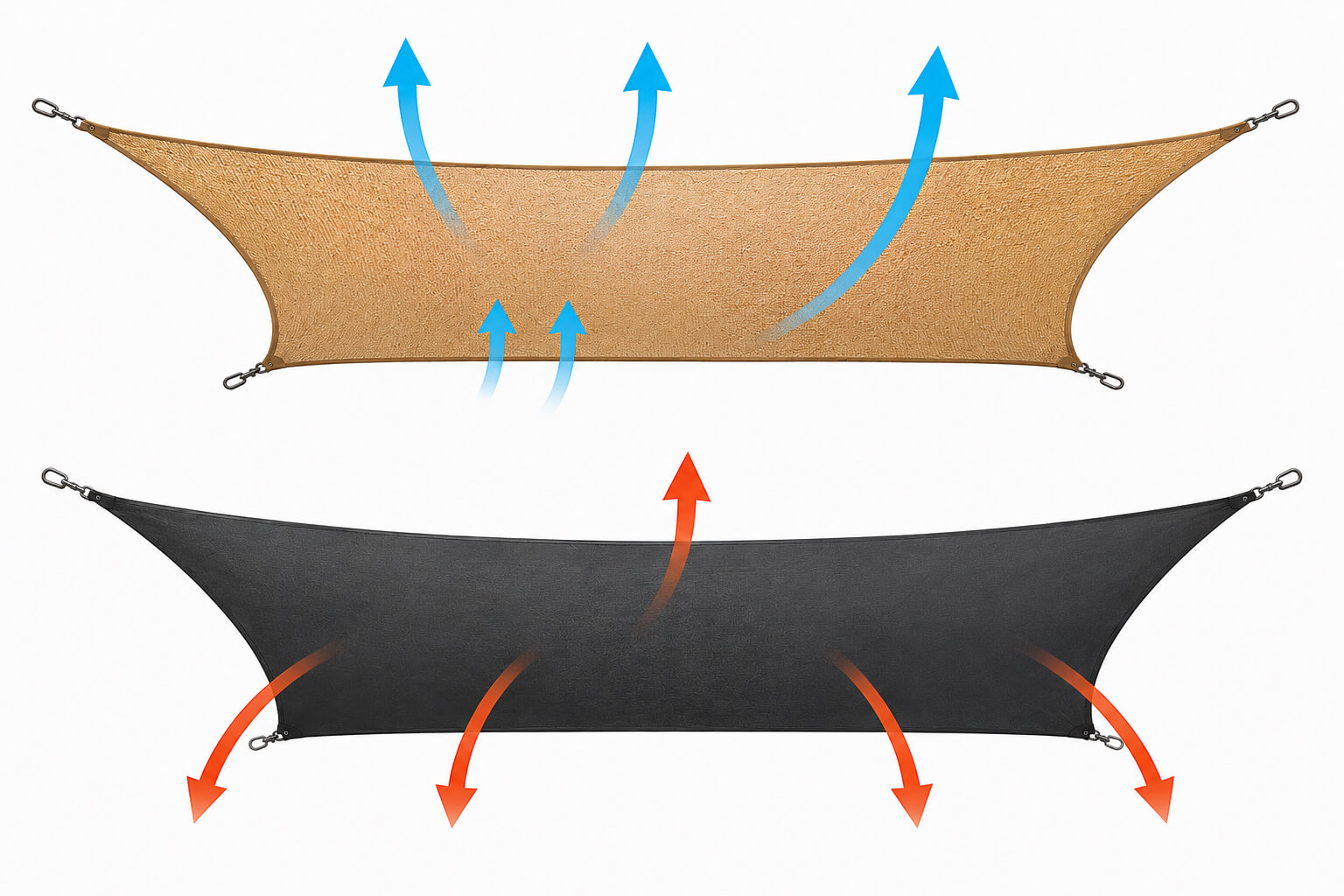
Coolaroo is one of the world’s leading specialists in outdoor shade fabrics and shade solutions, with more than 50 years of experience in shade backed by GALE Pacific’s technical fabric expertise. Its knitted HDPE shade sails are designed to provide effective protection from strong sun and UV while allowing air to circulate through the fabric. In hot weather, that breathability is an important advantage: air can pass through the knitted fabric and it allows accumulated hot air beneath the sail to escape upwards through the canopy. A waterproof shade sail is designed for a different priority — keeping rain out — but its solid membrane also prevents hot air escaping through the canopy.
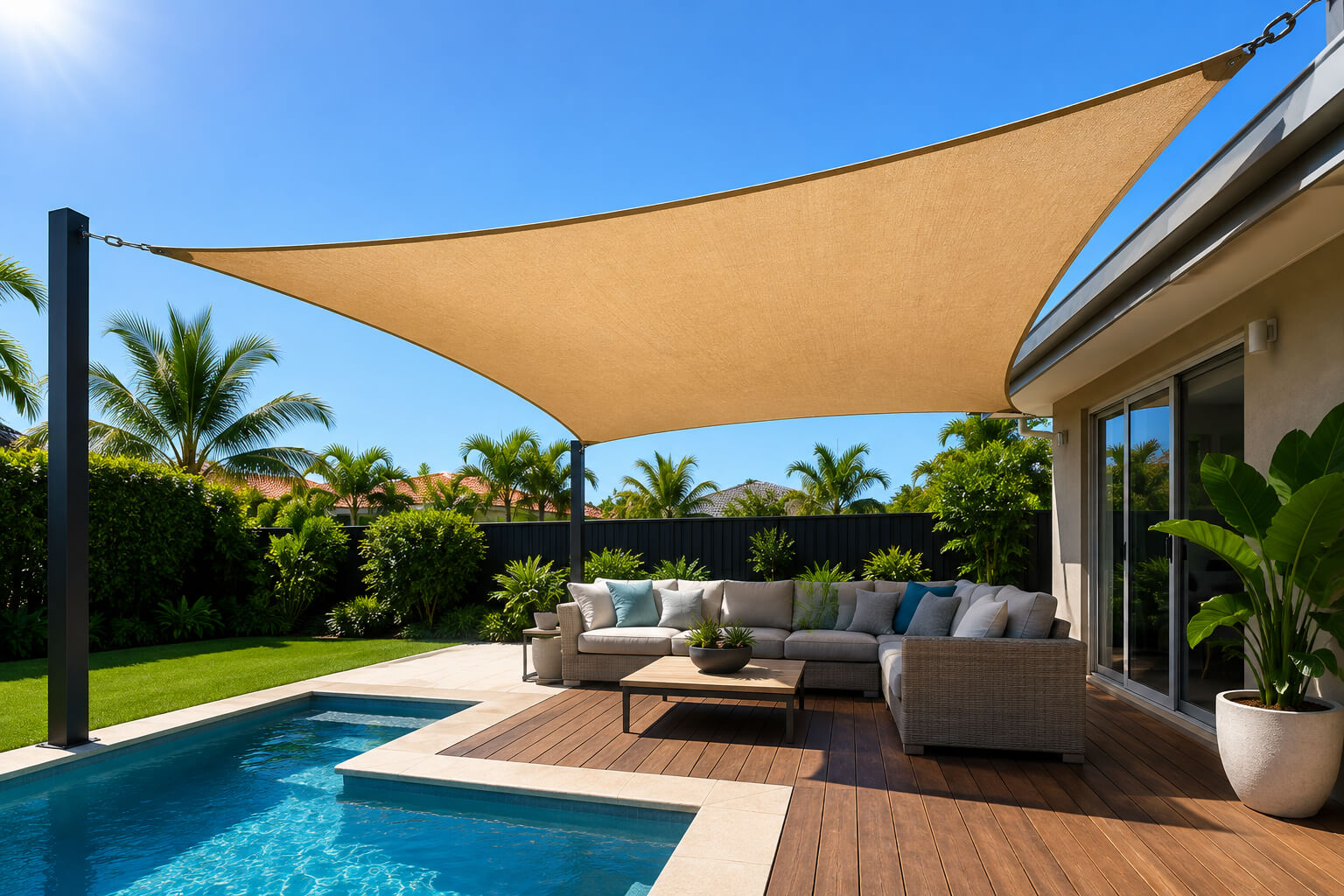
Our recommendation for effective shade
Choose breathable when…
your priority is sun and UV protection in hot weather: knitted HDPE creates shade, allows air to circulate and allows accumulated hot air beneath the sail to escape upwards through the fabric.
Choose waterproof when…
stopping rain is the overriding requirement and the installation can provide sufficient pitch, correct tension, reliable drainage and anchors designed for a solid membrane.
Breathable vs waterproof shade sails
| Factor | Breathable knitted HDPE | Waterproof shade sail |
|---|---|---|
| Best for | Shade, heat, patios, gardens, pools and play areas | Rain protection where keeping the area underneath dry is the priority |
| Rain | With a well-tensioned sail installed on a slope, some light rain can run towards the lower edge. The knitted fabric remains permeable, however, so heavy or prolonged rain can pass through. | Stops rain when pitch and drainage are correctly designed |
| Airflow | Yes: air and heat can escape | Very limited: the fabric forms a solid membrane |
| Summer comfort | Excellent: less heat build-up | Can retain more heat beneath the sail |
| Wind behaviour | Allows some air through and normally presents less resistance to wind | Catches more wind and transfers greater loads to the structure |
| Water-pooling risk | Lower: the permeable fabric allows water to pass through | Significant if pitch, shape or tension are inadequate |
| Installation | Correct tension and structural anchors still essential | Tension, pitch, drainage and structural anchors are especially critical |
| The logical choice if… | sun and heat are the main problem | rain is the main problem |
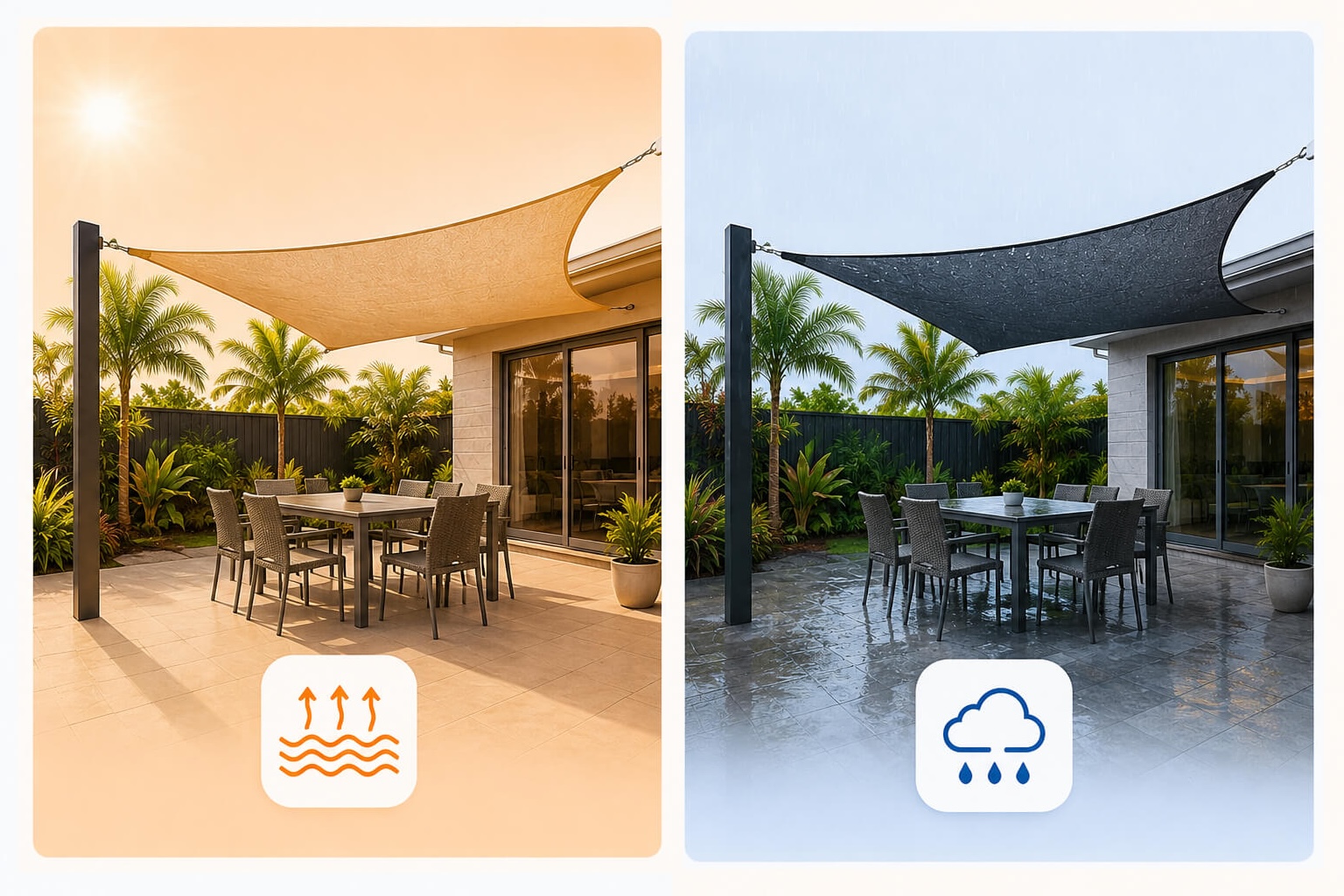
What is a breathable shade sail?
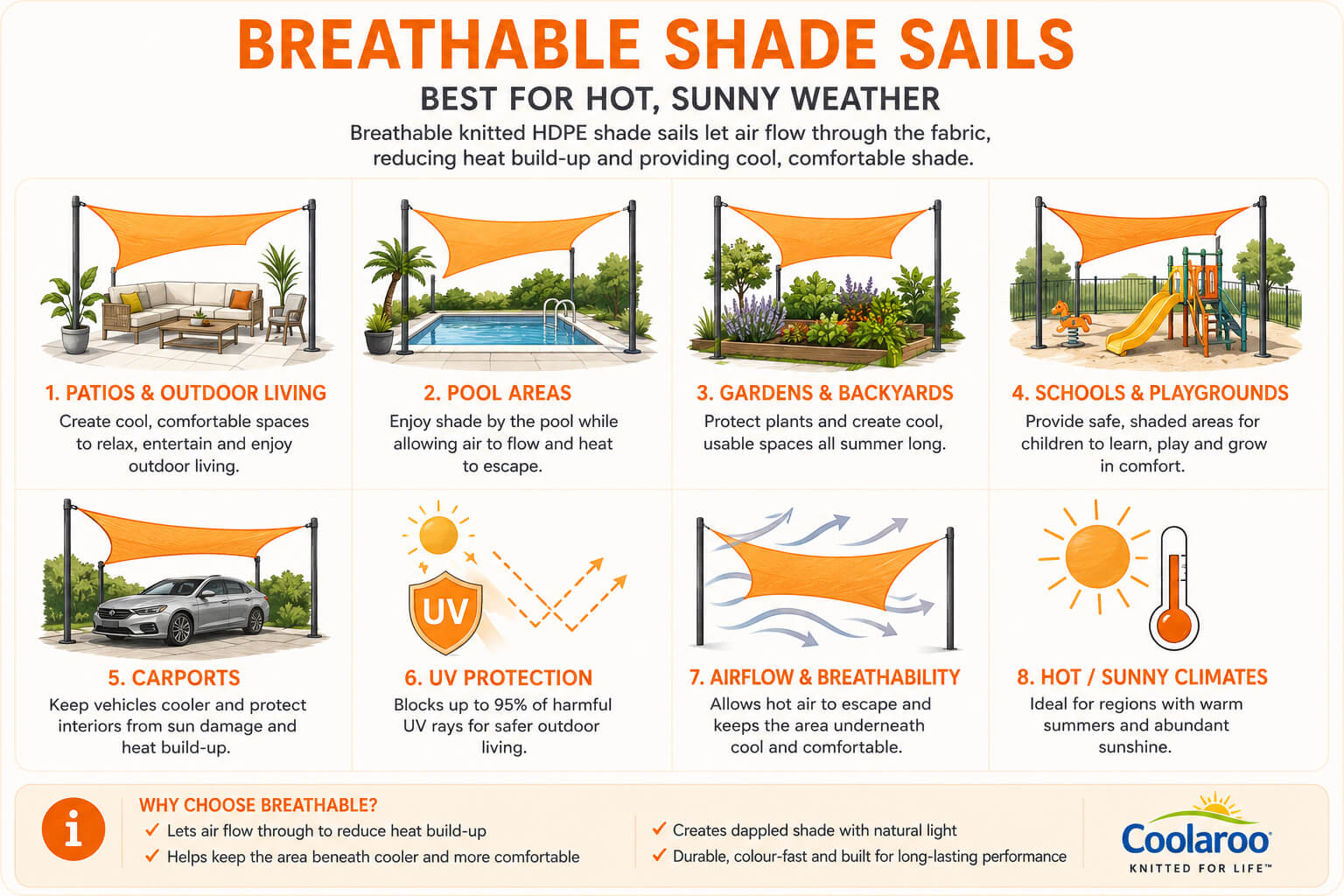
A breathable shade sail is normally made from knitted high-density polyethylene (HDPE). The knitted construction creates tiny openings through the fabric, allowing air and rainwater to pass while still providing effective protection from the sun.
That airflow is particularly useful over patios, gardens, swimming pools and play areas. Hot air can escape instead of being trapped beneath a solid membrane, helping the shaded space feel more comfortable on hot days.
What is a waterproof shade sail?
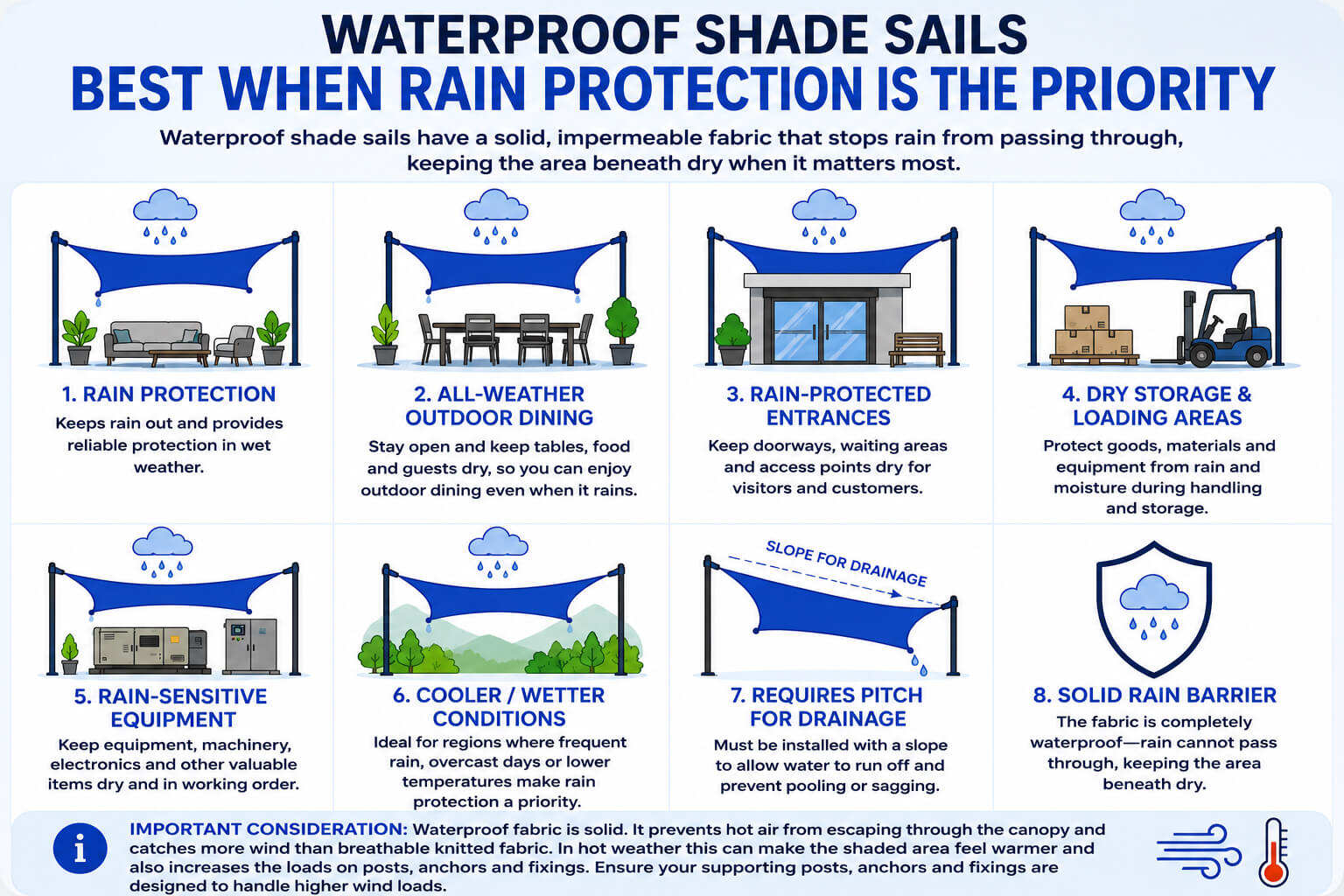
A waterproof shade sail uses a solid or coated fabric intended to stop water passing through it. Correctly installed, it can keep a dining table, doorway, furniture or work area dry as well as shaded.
The trade-off is that very little air or water can pass through the fabric. Wind therefore acts more strongly on the surface and every drop of rain has to be directed to a low edge. A waterproof sail should never be treated like a nearly flat tarpaulin.
Why breathable shade is more comfortable in hot weather
Hot air naturally rises. Under a Coolaroo knitted-HDPE sail, air can circulate through the fabric and accumulated hot air beneath the sail can escape upwards through the canopy. A waterproof membrane is solid and blocks that escape route, so in very hot sunshine more hot air can be retained beneath the cover.
That is exactly why we sell breathable Coolaroo shade sails for patios, gardens, pools, schools, restaurants, vehicles and other outdoor areas: when you buy a sail to protect people from sun, heat and UV, preserving airflow beneath the canopy is part of the comfort you are trying to create.
Which type performs better in wind?
No shade sail is free from wind loading: anchors, posts and correct tension remain essential. But knitted fabric lets some air pass through, whereas a waterproof membrane presents a much more closed surface.
With otherwise comparable installations, that normally means less wind resistance from breathable fabric. A waterproof sail can work very well, but its supporting structure must be designed for the additional loads and the sail must remain properly tensioned.
Why is pitch so important with a waterproof sail?
Water is heavy. If a waterproof sail is too flat or insufficiently tensioned, rain can collect in the centre and form a water pocket. The additional weight stretches the fabric and greatly increases the forces on seams, corners, posts and anchors.
A waterproof installation therefore needs a clear height difference between fixing points and an obvious drainage route to a low edge. Shape, pitch and tension are part of the drainage system, not optional finishing details.
Which type lasts longer?
There is no universal answer for every product. Service life depends on fabric quality, seams and reinforcement, UV resistance, hardware, tension, exposure and maintenance.
For an installation whose main purpose is shade, breathable fabric avoids the same water-retention risk as a waterproof membrane and allows some air to pass through. A waterproof sail can also provide a good service life when its structure, pitch, tension and drainage are correctly designed.
Which fabric suits which use?
Patio and garden
For patios and gardens used mainly in hot weather, we normally recommend a breathable Coolaroo sail: it cuts direct sun and UV without trapping heat beneath a solid membrane. Choose waterproof primarily when keeping the area dry during rain matters more than airflow and summer comfort.
Pool and play area
Breathable fabric is particularly effective: it provides shade and airflow without creating a large surface that can collect water.
Restaurant, café or dining area
For restaurant, café and outdoor-dining terraces used in hot weather, we normally recommend breathable shade: it protects customers from direct sun and UV while allowing rising hot air to escape. A waterproof sail can keep tables dry during rain, but the same solid membrane also restricts airflow. That comfort trade-off only makes sense where keeping the area dry is more important than hot-weather cooling.
Car, entrance or work area
For shade alone, breathable fabric is straightforward and effective. When water genuinely has to be kept out, waterproofing becomes the primary criterion.
Why Coolaroo uses breathable knitted HDPE
Coolaroo is a wholly owned subsidiary of Australian manufacturer GALE Pacific. GALE Pacific pioneered knitted shadecloth and has decades of experience developing technical textiles for intense sun and outdoor exposure.
Coolaroo fabric is engineered for long-term outdoor use, with long-lasting UV protection built into the core of every fibre of the fabric. Its knitted HDPE construction lets air circulate and heat escape, while the fibres do not absorb moisture. Depending on the range, Coolaroo shade products can block up to 95% of harmful UV radiation and are endorsed by Cancer Council Australia.
Coolaroo therefore has a clear purpose: durable, breathable sun protection rather than turning the sail into a roof. That is precisely the role of our Coolaroo shade sails: protecting patios, gardens, pools, schools, restaurants, vehicles and other outdoor spaces from sun and UV while preserving airflow beneath the sail.
Choose your breathable Coolaroo shade sail shape
Triangle
Three anchor points, a light appearance and excellent flexibility for combining several sails.
View triangular shade sails →Square
A broad, regular area of shade with four fixing points, ideal for patios and dining areas.
View square shade sails →Rectangle
Ideal for long or narrow spaces, large tables, patios and poolside areas.
View rectangular shade sails →Whichever fabric you choose, installation still matters
Breathable does not mean wind-proof, and waterproof does not automatically mean roof. Every shade sail must be correctly sized, firmly tensioned and attached to structurally suitable anchor points.
Our installation guide explains spacing, pitch, fixing heights, tension and suitable support structures.
For our Coolaroo shade sails we offer marine-grade 316 stainless-steel components, including turnbuckles, snap hooks, pad eyes and eye anchors depending on the fixing point. Every support and anchor point must still be suitable for the loads transmitted by the sail.
For sun, heat and UV protection, choose breathable Coolaroo shade
If your main aim is shade, effective UV protection and greater comfort on hot days, choose a breathable knitted-HDPE Coolaroo shade sail. If your main priority is instead to keep the area dry when it rains, choose a waterproof solution — taking account of the additional requirements for slope, drainage, tension and structural strength.
